Prompted CoT
Instruction or demonstrations at inference time
Parameters stay fixedCSE 151B · Interactive Survey
A raw model can recognize a problem’s shape and still skip the computation needed to solve it.
Reasoning creates room to compute, check, and revise before the final answer.
Click a module to see the mechanism, equation, and role in the encoder-decoder path.
Hover or focus a module to isolate it. Click to keep it selected.
Figure overview
PinnedEmbeddings move through repeated attention and feed-forward blocks before the output head predicts the next token.
The encoder builds contextual representations; the decoder uses causal self-attention and cross-attention to generate one token at a time.
The number of layers is fixed for every generated token.
1 of 7
Direct answering still computes, but it adds no separate pre-answer scratchpad.
Same model. More decoding steps before the answer.
Few-shot CoT: show worked reasoning examples in the prompt.
Zero-shot CoT: add a trigger such as “Let’s think step by step.”
Both methods generate intermediate tokens that act as a reusable workspace.
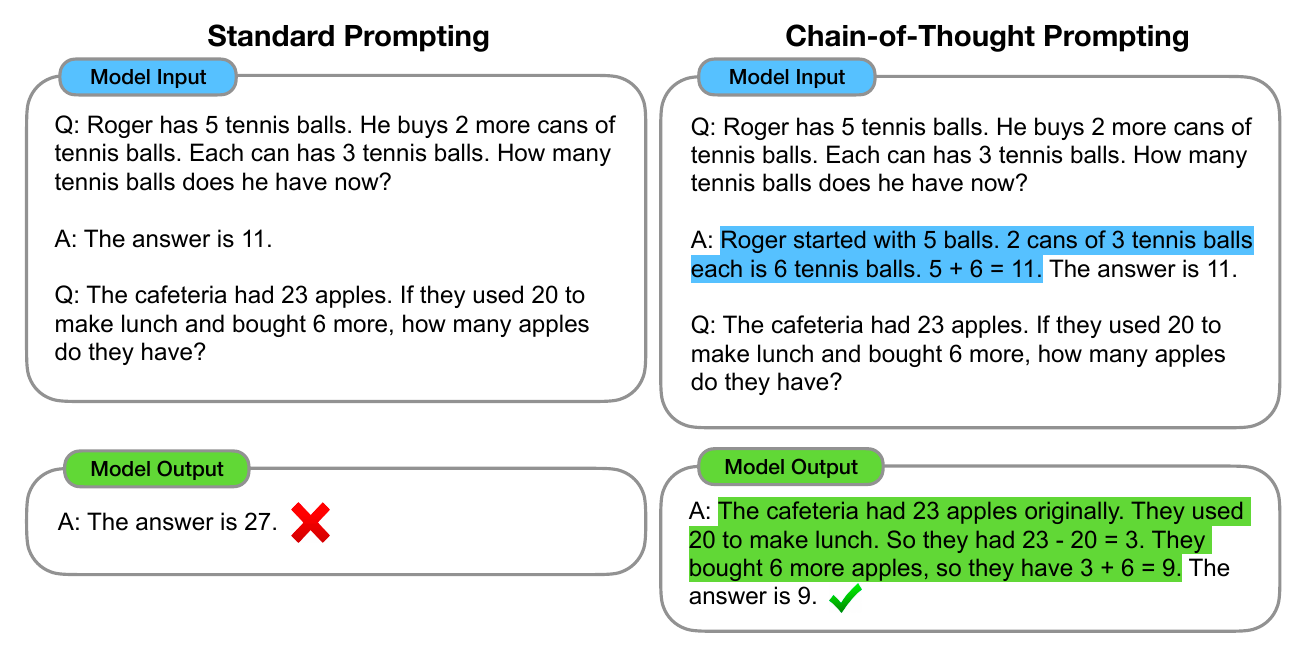
Instruction or demonstrations at inference time
Parameters stay fixedSFT, distillation, or reinforcement learning
Parameters changePrompting elicits a behavior without updating the model.
Training changes the behavior the model produces by default.
Click a component to inspect it.
Figure overview
PinnedQuiet-STaR samples hidden rationales, tests whether they improve future-token prediction, and reinforces useful thoughts.
Ordinary text supplies the supervision signal.
Pause Tokens are an intermediate step between chain-of-thought and Coconut.
Chain-of-thought adds readable reasoning tokens. Pause Tokens keep the extra sequence positions but remove the requirement that those positions contain meaningful reasoning text. Coconut goes further by reasoning in continuous latent states.
Pause tokens add sequence positions before the answer. The tokens carry no meaningful reasoning text, but their hidden states can help generate later answer tokens within a standard token-based Transformer.
Pause Tokens give the model more computation through extra token positions, without requiring readable intermediate steps.
Hover or focus a component to isolate it. Click to keep it selected.
Figure overview
PinnedPause-pretraining inserts learned pause tokens, skips their prediction loss, and keeps the original next-token targets.
The delay changes computation while revealing no intermediate rationale.
Trace how Coconut replaces sampled reasoning words with continuous hidden-state feedback.
Hover or focus a mechanism to isolate it. Click to keep it selected.
Figure overview
PinnedToken CoT repeatedly converts hidden states into words. Coconut keeps part of that computation in continuous hidden states.
Hover or focus a component to inspect it. Click a component to keep it selected, or start the walkthrough to follow the comparison in order.
1 of 7
Hidden describes visibility. Latent describes representation.
| Path | Pre-answer steps | Representation | Visible to user | Special training |
|---|---|---|---|---|
| Direct answer | No separate workspace | Standard hidden activations | Answer only | Not required |
| Prompted CoT | Yes | Discrete language tokens | Usually visible | No parameter update |
| Trained token reasoning | Yes | Discrete reasoning tokens | Visible, hidden, or summarized | Yes |
| Latent reasoning | Yes | Continuous hidden states | Usually hidden | Yes |
LLM reasoning developed by giving models more flexible computation between the question and the final answer, not simply by making thoughts visible or hidden.
Paper links and technical references mentioned throughout the presentation.
Figure-specific links on earlier slides open the cited page of each paper.